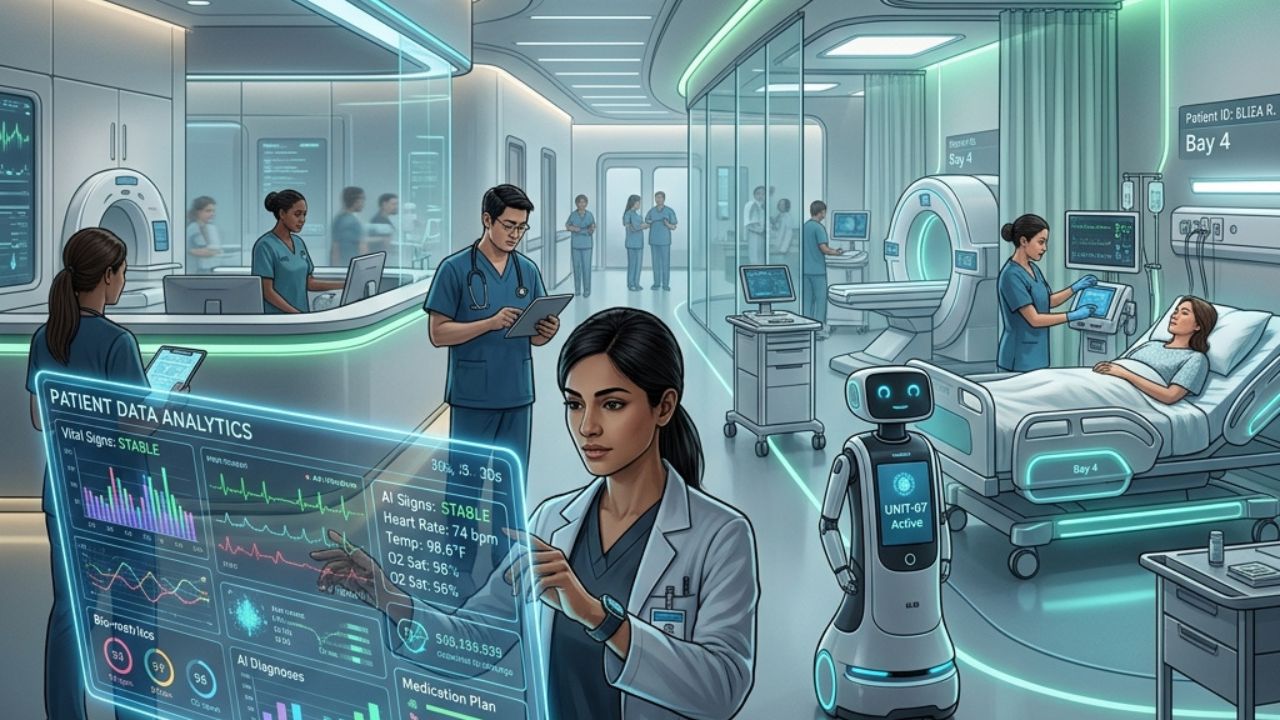
AI healthcare platforms like Epic Aura, Google Cloud Healthcare API, and Merative improve clinical decision-making, patient outcomes, and operational efficiency in modern hospitals. The best software depends on your facility’s specific infrastructure: choose Epic Aura for seamless electronic health record (EHR) integration, Google Cloud Healthcare API for advanced predictive analytics, and Merative for specialized diagnostic support.
Artificial intelligence is rapidly shifting from a theoretical concept to an operational necessity within modern clinical environments. Hospital administrators and clinical leaders face mounting pressures, including staffing shortages, rising operational costs, and the ongoing demand for improved patient outcomes. Advanced software solutions provide a viable path forward by turning massive amounts of siloed medical data into actionable insights.
The current landscape of AI healthcare platforms is vast and highly fragmented. Vendors offer solutions ranging from narrow, single-use algorithms to comprehensive enterprise-wide data ecosystems. Navigating this complex marketplace requires a clear understanding of your hospital’s technical readiness, clinical priorities, and long-term strategic goals. Selecting the wrong vendor often leads to costly integration failures, while the right partnership can fundamentally improve how a hospital delivers care.
This comprehensive guide will help hospital administrators, Chief Medical Information Officers (CMIOs), and IT leaders evaluate the top AI healthcare platforms. By comparing core functionalities, evaluating implementation complexities, and outlining the primary use cases for the leading solutions, this article provides the necessary framework to make an informed, data-driven software investment.
What are the key features to consider in AI healthcare platforms?
Selecting a vendor requires evaluating technical capabilities alongside clinical utility. Hospitals must prioritize platforms that align with their existing digital infrastructure while meeting strict regulatory standards.
How does the platform handle data integration and interoperability?
The foundational element of any functional AI system is data access. AI healthcare platforms must ingest structured and unstructured data from diverse sources, including electronic health records (EHRs), laboratory information systems, and picture archiving and communication systems (PACS). Hospitals should prioritize platforms that support modern interoperability standards like HL7 Fast Healthcare Interoperability Resources (FHIR). This ensures the AI platform can communicate seamlessly with existing legacy systems.
What clinical decision support capabilities are included?
Clinical decision support (CDS) tools analyze patient data in real-time to provide evidence-based treatment recommendations. Effective AI platforms surface relevant alerts to physicians regarding potential adverse drug interactions, sepsis risks, or deteriorating patient conditions. These alerts must be highly accurate and context-aware to prevent alarm fatigue among clinical staff.
How do predictive analytics improve patient outcomes and efficiency?
Predictive analytics enable hospitals to transition from reactive treatment to proactive care management. High-performing AI healthcare platforms analyze historical and real-time data to forecast patient readmission risks, predict ICU bed utilization, and optimize staff scheduling. Accurately predicting patient flow allows hospital administrators to allocate resources more effectively and reduce emergency department wait times.
What personalization and patient engagement tools are available?
Patient engagement directly influences clinical outcomes. Top AI platforms offer tools that personalize communication, automate follow-up scheduling, and deliver targeted educational materials based on a patient’s specific diagnosis. Natural language processing (NLP) chatbots can answer routine patient queries, freeing up administrative staff for more complex tasks.
Does the platform meet security, privacy, and compliance requirements?
Hospitals handle highly sensitive protected health information (PHI). Any AI healthcare platform deployed within a clinical setting must strictly adhere to the Health Insurance Portability and Accountability Act (HIPAA) in the United States, or the General Data Protection Regulation (GDPR) in Europe. Administrators must evaluate the vendor’s data encryption protocols, access controls, and audit logging capabilities.
How scalable is the solution across the hospital network?
A platform might perform well in a single department but fail when deployed hospital-wide. Scalability is a critical decision criterion. The chosen AI healthcare platform must handle increasing data volumes and support integration with the hospital’s primary EHR systems, such as Epic, Cerner, or MEDITECH, without degrading system performance.
Deep Dive: What are the top AI healthcare solutions for hospitals?
To provide a practical framework for evaluation, we will analyze three dominant AI healthcare platforms utilized by major hospital networks today: Epic Aura, Google Cloud Healthcare API, and Merative.
Epic Aura
Epic Systems is a dominant force in the EHR market, and Epic Aura is its dedicated suite of AI and machine learning tools designed to integrate directly into the physician’s existing workflow.
Core functionalities and unique selling points
Epic Aura operates natively within the Epic EHR ecosystem. This native integration eliminates the need for third-party dashboards, allowing physicians to access AI-driven insights directly within the patient chart. Aura supports both Epic-developed algorithms and third-party models deployed via the Epic App Orchard.
Use cases in hospitals
Hospitals primarily use Epic Aura for real-time clinical workflows. The platform excels at identifying patients at risk of clinical deterioration, such as predicting sepsis onset hours before symptoms become critical. It also streamlines administrative tasks by using AI to draft clinical notes and optimize billing codes.
Strengths and limitations
The primary strength of Epic Aura is user adoption. Physicians do not need to learn a new interface, which drastically reduces training time. However, Epic Aura is exclusively available to hospitals already using the Epic EHR. Facilities operating on Cerner or custom EHRs cannot utilize this platform.
Google Cloud Healthcare API
Google Cloud offers a highly scalable, infrastructure-focused AI solution that helps hospitals aggregate, clean, and analyze complex medical data across disparate systems.
Core functionalities and unique selling points
Google Cloud Healthcare API excels at managing massive datasets and applying advanced natural language processing (NLP) and machine learning models to unstructured data. It provides robust FHIR, HL7v2, and DICOM APIs, making it a powerful engine for interoperability. The platform’s Vertex AI integration allows hospital data scientists to build, train, and deploy custom machine learning models.
Use cases in hospitals
Large research hospitals utilize Google Cloud to parse unstructured clinical notes, extract relevant medical entities, and identify cohorts for clinical trials. It is also heavily used for medical imaging analysis, where machine learning algorithms assist radiologists in detecting anomalies in X-rays and MRIs faster than manual review.
Strengths and limitations
Google Cloud Healthcare API offers unmatched computational power and flexibility for custom AI development. However, it requires a high level of technical expertise to implement and manage. Hospitals without dedicated data science teams or robust IT departments will struggle to maximize the platform’s value.
Merative (Formerly IBM Watson Health)
Merative provides enterprise-grade AI solutions focused on clinical decision support, imaging analytics, and population health management.
Core functionalities and unique selling points
Merative specializes in deep clinical knowledge extraction. The platform cross-references patient data against vast libraries of medical literature, clinical trial data, and treatment guidelines to provide evidence-based recommendations. Its Merge PACS system is widely recognized for infusing AI directly into the radiology workflow.
Use cases in hospitals
Oncology departments frequently use Merative to assist in developing personalized cancer treatment plans. The platform analyzes a patient’s genetic profile and medical history, matching them with relevant clinical trials or targeted therapies. Additionally, hospitals use Merative’s population health tools to identify high-risk patient demographics and proactively manage chronic diseases.
Strengths and limitations
Merative provides exceptional value in complex diagnostic scenarios and specialized clinical fields like oncology and radiology. Conversely, the platform has historically faced criticism for long implementation timelines and high costs, making it a better fit for large, well-funded hospital networks rather than small community hospitals.
Comparative Analysis: How do the top AI healthcare platforms stack up?
To facilitate decision-making, hospital administrators must compare these platforms based on cost, complexity, and specific clinical needs.
How do cost considerations and ROI compare?
- Epic Aura: Pricing is typically bundled into existing Epic contracts or involves module-specific licensing fees. The return on investment (ROI) is realized quickly through reduced administrative burden and improved clinical documentation.
- Google Cloud Healthcare API: Operates on a pay-as-you-go cloud consumption model. Initial costs can be low, but expenses scale rapidly with data storage and computational usage. ROI is often long-term, driven by operational efficiencies and research breakthroughs.
- Merative: Requires significant upfront capital investment for licensing and deployment. ROI depends heavily on improving outcomes in high-cost service lines, such as oncology or radiology.
What is the best fit scenario for each platform?
Choose Epic Aura if your hospital already relies on Epic for its EHR and your primary goal is to improve physician workflows without introducing new software interfaces.
Choose Google Cloud Healthcare API if your organization has a dedicated data science team, manages massive volumes of unstructured data, and wants to build custom predictive models.
Choose Merative if your hospital specializes in complex care (like oncology), relies heavily on advanced medical imaging, and requires deep, evidence-based diagnostic support.
What are the current challenges and future trends in AI healthcare adoption?
Integrating AI into clinical environments is not without significant hurdles. Hospitals must navigate a complex web of ethical, regulatory, and operational challenges.
How do hospitals address ethical considerations and bias in AI?
AI algorithms are only as objective as the data used to train them. If an AI healthcare platform is trained on historical data that reflects systemic healthcare disparities, the algorithm will likely perpetuate those biases. Hospitals must rigorously audit AI recommendations to ensure they do not disadvantage specific patient demographics based on race, gender, or socioeconomic status.
What are the regulatory hurdles and evolving standards?
The regulatory framework governing AI in healthcare is actively evolving. In the United States, the Food and Drug Administration (FDA) classifies certain AI algorithms as Software as a Medical Device (SaMD), requiring stringent clinical validation before deployment. Hospital compliance officers must ensure any platform adopted adheres to the latest FDA guidance and data privacy laws.
How will human-AI collaboration evolve?
The most successful AI implementations augment human expertise rather than replace it. The concept of “human-in-the-loop” AI ensures that algorithms provide recommendations, but the final diagnostic or treatment decision remains with the licensed physician. This collaborative approach mitigates risk and helps build trust among clinical staff wary of automated systems.
Next Steps for Strategic AI Adoption in Hospitals
The integration of artificial intelligence into hospital operations is no longer optional for facilities that want to remain competitive and deliver high-quality care. AI healthcare platforms possess