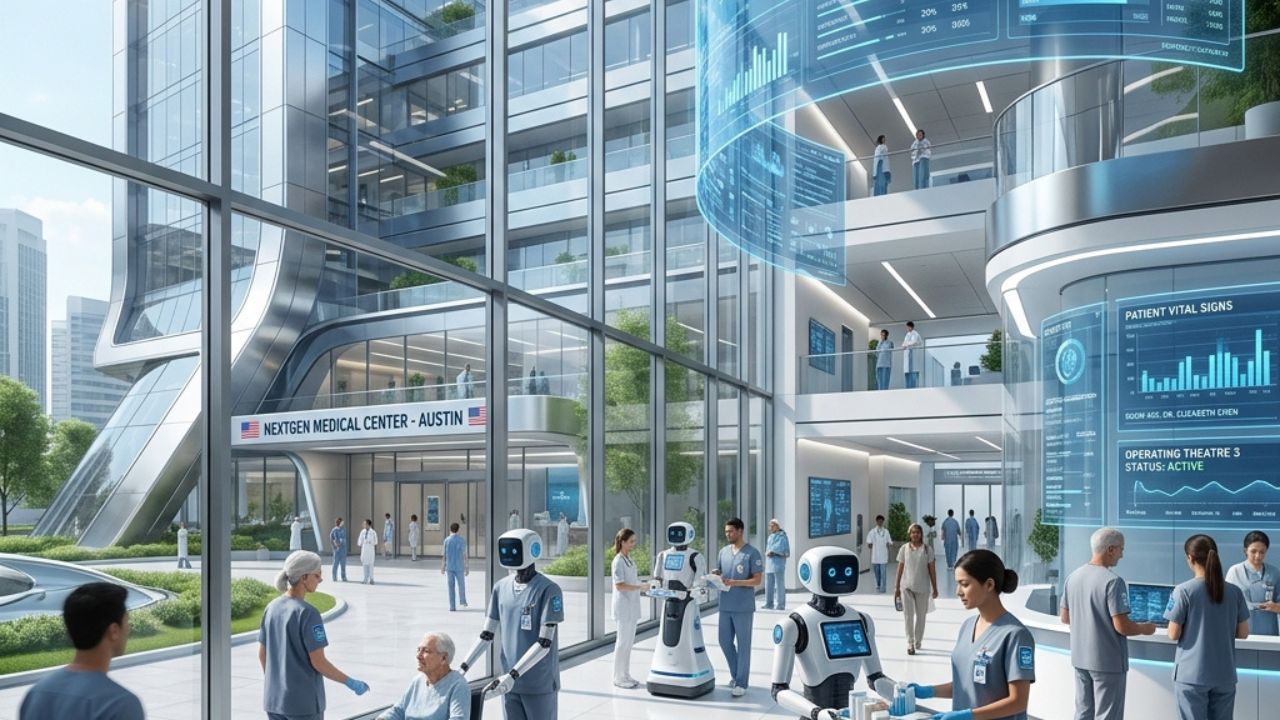
AI-powered hospitals in the USA are using machine learning, predictive analytics, and robotic systems to improve patient outcomes, reduce costs, and streamline hospital operations. Adoption is accelerating rapidly, with major health systems like Mayo Clinic and Cleveland Clinic already deploying AI across diagnostics, surgery, and administration.
The operating room of the future doesn’t look like science fiction anymore. Across the United States, hospitals are deploying artificial intelligence to read CT scans, predict patient deterioration, automate insurance claims, and guide robotic surgeons with sub-millimeter precision. What was once theoretical is now embedded in clinical workflows at some of the country’s most respected health systems.
This shift isn’t happening slowly. According to a 2023 report by Accenture, the AI in healthcare market is projected to reach $45 billion by 2026. Hospitals that once debated whether to adopt AI are now debating how fast to scale it. The stakes are enormous—both for patient safety and institutional survival in an era of thinning margins and growing demand.
So what does an AI-powered hospital actually look like? Which technologies are making the biggest difference? And what challenges still stand in the way of widespread adoption? This post breaks it all down.
What Does an AI-Powered Hospital Look Like in Practice?
An AI-powered hospital doesn’t replace doctors with robots. The more accurate picture is a clinical environment where AI handles the data-heavy, time-consuming tasks that create bottlenecks—freeing physicians, nurses, and administrators to focus on judgment, empathy, and complex decision-making.
At its core, an AI-powered hospital integrates machine learning algorithms into existing electronic health record (EHR) systems, imaging platforms, and operational software. These systems analyze patient data in real time, surface early warning signals, and recommend evidence-based interventions.
Some hospitals are further along than others. Mayo Clinic, for example, has partnered with Google Health to develop AI tools for early detection of cardiac conditions. Cedars-Sinai Medical Center in Los Angeles uses a predictive AI platform called “Corti” to flag patients at risk of sepsis before symptoms become critical. These aren’t pilot programs—they’re live, operational systems treating real patients every day.
How Is AI Being Used in US Hospital Diagnostics?
Diagnostic accuracy is one of the most well-documented applications of AI in healthcare. Radiology and pathology departments have been early adopters, largely because their work involves analyzing large volumes of visual data—exactly what modern machine learning models excel at.
AI in medical imaging and radiology
The FDA has cleared more than 500 AI-enabled medical devices as of 2023, a significant portion of which relate to imaging. AI algorithms trained on millions of scans can detect anomalies—tumors, fractures, hemorrhages—with accuracy rates that rival, and in some cases exceed, those of experienced radiologists.
Aidoc, an AI radiology company used in over 1,000 hospitals globally, helps radiologists prioritize urgent cases by flagging life-threatening findings within seconds of a scan being completed. The result: faster diagnosis, faster treatment, better outcomes.
How AI is improving early disease detection in hospitals
Beyond radiology, AI is being used to identify disease risk earlier than traditional screening methods allow. Google Health’s AI model for mammography screening demonstrated a 5.7% reduction in false positives and a 9.4% reduction in false negatives compared to human radiologists, according to a study published in Nature. Earlier detection of breast cancer translates directly into better survival rates and less aggressive treatment protocols.
What Role Does Predictive AI Play in Patient Safety?
One of the most impactful applications of hospital AI has nothing to do with imaging. Predictive analytics—systems that monitor patient vitals, lab results, and clinical notes to anticipate deterioration—are quietly saving lives across ICUs and general wards.
Sepsis kills more than 270,000 Americans each year, according to the CDC. It is notoriously difficult to detect early because its symptoms overlap with dozens of other conditions. AI systems trained on retrospective patient data can now identify the subtle, early-stage patterns that precede sepsis onset hours before a clinician would typically catch them.
Johns Hopkins Hospital developed an AI system called “Targeted Real-time Early Warning System” (TREWS) specifically to address sepsis detection. A study published in Nature Medicine in 2023 found that TREWS helped clinicians treat sepsis faster, leading to measurable reductions in mortality. That’s not a marginal gain—that’s lives saved at scale.
Predictive AI is also being applied to hospital readmission prevention. The Centers for Medicare & Medicaid Services (CMS) penalizes hospitals financially for excess readmissions. AI models that analyze discharge data, social determinants of health, and follow-up care plans can identify high-risk patients before they leave the building—allowing care teams to intervene proactively.
How Are AI-Powered Robots Changing Hospital Operations and Surgery?
Robotic systems in hospitals predate the current AI wave, but modern AI has dramatically expanded their capabilities. The most well-known example is the da Vinci Surgical System, which enables minimally invasive surgeries with tremor-free precision. Over 1.5 million robotic-assisted surgeries were performed using da Vinci systems in 2022 alone.
Beyond the operating room, autonomous robots handle tasks like pharmacy dispensing, specimen transport, and room disinfection. Hospitals in California and Texas have deployed UV-C disinfection robots to sanitize patient rooms between admissions—a process that takes 10 minutes instead of the 30 required by manual cleaning, with greater consistency.
Administrative AI is another major operational driver. Natural language processing (NLP) tools now transcribe and code physician notes automatically, reducing the documentation burden that contributes heavily to clinician burnout. A 2022 study in JAMA Internal Medicine found that physicians spend nearly two hours on administrative work for every hour of direct patient care. AI documentation tools are beginning to chip away at that ratio.
What Are the Biggest Challenges Facing AI Adoption in US Hospitals?
Despite meaningful progress, the path to fully AI-integrated hospitals is not without friction. Several barriers remain significant.
Data quality and interoperability
AI models are only as good as the data they’re trained on. Many US hospitals still operate on legacy EHR systems that don’t communicate cleanly with one another. Fragmented data creates gaps that reduce model accuracy and limit the ability to train robust, generalizable AI systems. The 21st Century Cures Act has pushed for greater interoperability, but implementation remains inconsistent across health systems.
Algorithmic bias and health equity concerns
AI models trained on historical clinical data can inadvertently encode existing disparities. A widely cited 2019 study in Science found that a commercial algorithm used by hospitals systematically underestimated the health needs of Black patients relative to white patients with similar conditions. As hospitals expand AI deployment, ensuring that models are tested across diverse patient populations is not optional—it’s a clinical and ethical imperative.
Regulatory and liability questions
The FDA’s framework for AI-enabled medical devices continues to evolve. Unlike traditional software, AI systems learn and update over time, which creates challenges for pre-market approval processes designed for static products. Questions around liability—who is responsible when an AI diagnostic recommendation contributes to a harmful outcome—remain partially unresolved and are likely to shape adoption decisions for years.
Clinician trust and change management
Technology doesn’t transform healthcare; adoption does. Many clinicians remain skeptical of AI tools, particularly when the model’s reasoning is opaque. Explainable AI (XAI)—systems that can articulate why they flagged a particular patient or recommended a specific treatment—is gaining traction as a response to this concern. Hospitals that have successfully scaled AI adoption tend to share one common trait: they invested heavily in clinician education and co-design, rather than deploying tools from the top down.
Which US Hospital Systems Are Leading AI Integration?
Several health systems have emerged as clear leaders in AI adoption.
Mayo Clinic has built one of the largest clinical AI platforms in the country, with over 100 AI projects spanning cardiology, oncology, and neurology. Mayo’s partnership with Google Health focuses on surfacing AI insights directly within clinical workflows, rather than requiring clinicians to use separate tools.
Cleveland Clinic has partnered with IBM and Microsoft to develop AI tools for genomics, drug discovery, and operational efficiency. Its collaboration with IBM Research is focused on quantum computing applications for drug interaction modeling.
Kaiser Permanente stands out for its scale. With over 12.7 million members and a fully integrated EHR system, Kaiser has the data infrastructure to train AI models at a scope that most hospital systems cannot match.
Mass General Brigham launched a dedicated AI center in 2020 and has been particularly active in applying NLP to clinical documentation and patient communication tools.
The Road Ahead: What Will AI-Powered Hospitals Look Like in 2030?
The trajectory is clear, even if the timeline is debated. Analysts at McKinsey estimate that AI could generate $150 billion in annual savings for the US healthcare economy by 2026 through improved efficiency alone. Add diagnostic accuracy improvements and reduced adverse events, and the potential value compounds further.
Ambient clinical intelligence—AI that listens to patient-provider conversations and automatically generates notes, orders, and follow-up plans—is one of the most watched emerging capabilities. Microsoft’s Nuance DAX Copilot is already deployed in hundreds of US hospitals and is showing early promise in reducing documentation time by up to 50%.
Precision medicine, powered by AI analysis of genomic and phenotypic data, will gradually shift treatment from population-level protocols to individualized care plans. The National Institutes of Health’s “All of Us” research program, which aims to collect health data from one million Americans, is designed in part to fuel this kind of AI-driven personalization.
A Smarter Healthcare System Starts Here
AI-powered hospitals represent the most significant structural shift in American healthcare since the introduction of electronic health records. The technology is no longer emerging—it’s here, operating in real clinical environments, with documented results.
For healthcare leaders, the question is no longer whether to adopt AI, but how to do so responsibly: with attention to equity, transparency, clinician engagement, and rigorous outcome measurement. For patients, the promise is real and tangible—earlier diagnoses, safer hospital stays, and care that is increasingly shaped by their individual biology and circumstances.
The hospitals leading this transformation aren’t waiting for perfect conditions. They’re building the infrastructure, training their teams, and learning from every deployment. The gap between early adopters and late movers is widening. The best time to close it was yesterday. The second best time is now.
Frequently Asked Questions About AI-Powered Hospitals
What is an AI-powered hospital?
An AI-powered hospital integrates artificial intelligence into clinical and administrative operations—including diagnostics, patient monitoring, surgery, and documentation—to improve accuracy, efficiency, and patient outcomes. AI-powered hospitals still rely heavily on human clinicians; AI augments their decision-making rather than replacing it.
Which US hospitals are most advanced in AI adoption?
Mayo Clinic, Cleveland Clinic, Kaiser Permanente, and Mass General Brigham are widely recognized as leaders in clinical AI integration. Each has formed partnerships with major technology companies and invested in dedicated AI research and deployment programs.
Is AI in hospitals safe for patients?
AI tools used in US hospitals must receive FDA clearance before clinical deployment, and they undergo ongoing monitoring. Risks exist—including algorithmic bias and edge-case errors—but hospitals with strong governance frameworks and rigorous evaluation processes have demonstrated meaningful safety improvements, particularly in early disease detection and sepsis prevention.
How does AI reduce costs for hospitals?
AI reduces hospital costs by automating administrative tasks (such as clinical documentation and billing), reducing diagnostic errors, preventing costly readmissions, and optimizing operational workflows. McKinsey estimates AI could save the US healthcare system $150 billion annually by 2026.
What are the main barriers to AI adoption in US hospitals?
The primary barriers include fragmented health data and poor interoperability between systems, algorithmic bias in models trained on non-diverse datasets, evolving FDA regulatory frameworks, and clinician skepticism toward AI tools with limited explainability.
Will AI replace doctors and nurses in hospitals?
No. AI is designed to augment clinical judgment, not replace it. The most effective AI hospital implementations focus on removing administrative burden and surfacing data-driven insights, leaving complex medical decision-making, patient communication, and empathetic care firmly in the hands of human clinicians.