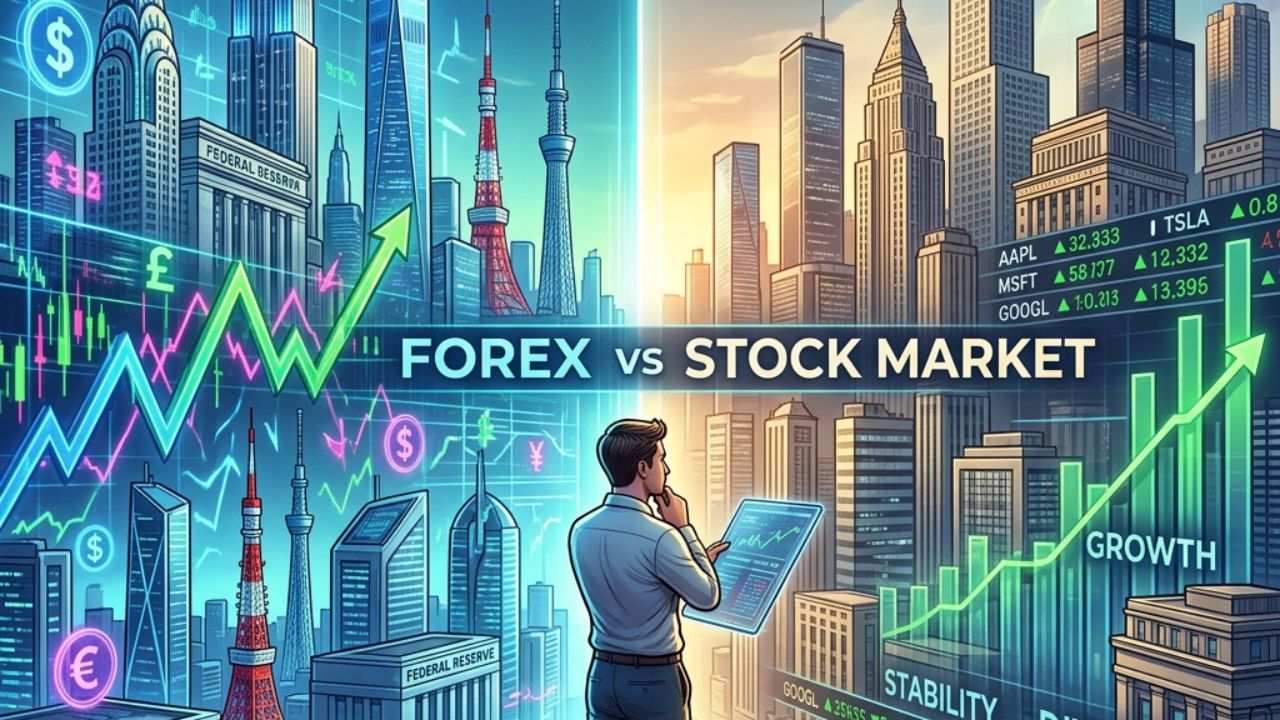
The forex market offers high liquidity and 24/5 access but comes with significant volatility and complexity. The stock market provides long-term growth potential and ownership in companies but requires more capital. The right choice in 2026 depends on your risk tolerance, time horizon, and financial goals.
Every investor eventually faces the same question: do you trade currencies or equities? Both markets have made fortunes for those who understood them—and wiped out accounts for those who didn’t.
The forex market and the stock market sit at opposite ends of the investment spectrum. One is the world’s largest financial market, processing over $7.5 trillion in daily transactions (Bank for International Settlements, 2022). The other has created more long-term wealth for everyday investors than perhaps any other asset class in history. Choosing between them isn’t simply a matter of preference. It’s a strategic decision that should be grounded in a clear understanding of how each market works, what risks each carries, and what the economic landscape of 2026 looks like.
This post breaks down both markets in detail—covering structure, advantages, drawbacks, and the key forces shaping each in 2026. By the end, you’ll have a clearer picture of where your money belongs.
What Is the Forex Market, and How Does It Work?
The foreign exchange (forex) market is a decentralized global marketplace where currencies are bought and sold. Unlike stock exchanges, forex has no central location. It operates through a global network of banks, brokers, and financial institutions, running 24 hours a day, five days a week across major financial hubs—Sydney, Tokyo, London, and New York.
Key players include central banks (which influence currency values through monetary policy), commercial banks, institutional investors, and retail traders. Retail participation has grown significantly over the past decade, driven by accessible online platforms and low entry barriers.
What are the main advantages of forex trading?
High liquidity: The sheer volume of daily transactions means large positions can be entered and exited quickly with minimal price impact.
24/5 market access: Forex operates across time zones, giving traders the flexibility to respond to global events as they unfold—day or night.
Leverage opportunities: Forex brokers commonly offer leverage ratios of 50:1 or higher, allowing traders to control large positions with relatively small capital.
Lower transaction costs: Spreads in major currency pairs like EUR/USD are often tighter than brokerage fees on equities, reducing the cost per trade.
What are the main disadvantages of forex trading?
High leverage cuts both ways. While it amplifies gains, it magnifies losses just as quickly—sometimes wiping out accounts within hours during volatile sessions. Forex also demands a deep understanding of macroeconomic indicators, geopolitical dynamics, and central bank policy. Newcomers often underestimate this learning curve.
Regulatory oversight varies significantly by country. Some jurisdictions offer robust investor protections; others provide very little. Traders operating in loosely regulated environments face additional counterparty risk.
What factors will influence forex markets in 2026?
Three forces stand out:
- Geopolitical events: Ongoing tensions in Eastern Europe, shifting trade alliances, and energy market volatility all create currency fluctuations that traders must navigate.
- Interest rate differentials: As central banks in the US, EU, and emerging markets adjust rates in response to inflation and growth pressures, yield differentials will continue driving significant currency flows.
- Economic indicators: GDP growth, employment data, and inflation reports remain the primary drivers of short-term currency movements.
What Is the Stock Market, and How Does It Work?
The stock market is a collection of exchanges—such as the NYSE, NASDAQ, and LSE—where shares of publicly listed companies are bought and sold. When you purchase stock, you acquire a fractional ownership stake in that company, entitling you to a portion of its profits (through dividends) and a share of its growth (through capital appreciation).
Key participants include corporations raising capital through IPOs, institutional investors like pension funds and mutual funds, and millions of retail investors. Stock indices such as the S&P 500, the Dow Jones Industrial Average, and the FTSE 100 track the collective performance of major listed companies, serving as benchmarks for overall market health.
What are the main advantages of investing in the stock market?
Long-term return potential: Historically, the S&P 500 has delivered an average annual return of approximately 10% before inflation (Investopedia). Over decades, compounding turns modest contributions into substantial wealth.
Ownership in companies: Shareholders benefit directly from corporate growth, innovation, and profitability—not just price movements.
Regulation and transparency: Stock markets in developed economies are heavily regulated. Companies are required to disclose financial results, material events, and risk factors, giving investors a clearer basis for decision-making.
Diversification: From blue-chip equities to growth stocks, REITs, ETFs, and sector-specific funds, the stock market offers a breadth of investment options that allow for sophisticated portfolio construction.
What are the main disadvantages of stock market investing?
Market volatility can be severe. The COVID-19 crash of March 2020 saw the S&P 500 drop over 30% in a matter of weeks. Investors who panic-sell during downturns often lock in losses they would have recovered had they stayed the course.
Getting started requires meaningful capital, particularly if you want adequate diversification. Psychological biases—fear, greed, overconfidence—also pose a persistent challenge. Even experienced investors make emotionally-driven decisions that undermine long-term returns.
What factors will influence stock markets in 2026?
- Corporate earnings and economic growth: Revenue and profit trends remain the bedrock of stock valuations. A slowdown in consumer spending or corporate investment could weigh on equity prices.
- Technological advancements: AI integration, automation, and the continued expansion of cloud computing are reshaping corporate profitability across sectors—creating both winners and losers.
- Regulatory changes: Antitrust scrutiny of Big Tech, ESG disclosure requirements, and evolving tax policy will all influence stock performance in specific industries.
Forex vs. Stock Market: A Side-by-Side Comparison for 2026
Which market carries more risk—forex or stocks?
Forex carries a higher short-term risk profile. Leverage amplifies both gains and losses, and currency markets react instantly to macroeconomic news. The stock market also carries risk—particularly around earnings announcements and macroeconomic shifts—but the long-term trajectory of diversified equity portfolios has historically trended upward.
Which market offers better return potential?
The answer depends entirely on the timeframe. Skilled forex traders can generate substantial returns over short periods, but consistency is rare. Studies suggest that the majority of retail forex traders lose money over time. Equity investors with diversified, long-term portfolios have historically outperformed most active trading strategies.
How do liquidity levels compare?
Forex wins on liquidity by a wide margin. With $7.5 trillion in daily volume, major currency pairs can be traded in virtually any size without significant price impact. Stock market liquidity varies; large-cap equities like Apple or Microsoft are highly liquid, while small-cap stocks can be difficult to exit quickly.
What capital is required to get started?
Forex is more accessible from a capital standpoint. Some brokers allow accounts with as little as $100, and leverage means smaller deposits can control larger positions. Stock investing, particularly with a goal of meaningful diversification, typically requires more upfront capital—though fractional share investing has lowered the barrier substantially.
How are each market’s regulatory environments different?
The stock market, particularly in the US and EU, operates under strict regulatory frameworks overseen by bodies like the SEC and FCA. Forex regulation is more fragmented globally, with standards varying widely between jurisdictions. For investors prioritizing regulatory protection, equities offer greater assurance.
Which market suits short-term traders vs. long-term investors?
Forex is inherently a short-to-medium-term market. Most forex strategies are built around hours, days, or weeks—not years. Stock investing, by contrast, rewards patience. Long-term equity investors benefit from compounding returns, dividend reinvestment, and the general expansion of corporate earnings over time.
Which market offers better diversification?
Stocks offer superior diversification options. Through ETFs and index funds, investors can gain exposure to hundreds or thousands of companies across geographies and sectors. Forex diversification is more limited; pairs are inherently correlated through shared currencies, and most retail traders focus on a handful of major pairs.
Who Should Invest Where in 2026?
Is forex trading right for aggressive, active traders?
Forex suits traders who are comfortable with risk, have time to actively monitor positions, and possess a strong grasp of macroeconomic dynamics. The 24/5 market structure and leverage options make forex particularly appealing to those seeking high-frequency opportunities. That said, success requires discipline, a tested strategy, and robust risk management—stop-losses are not optional.
Are stocks better for long-term investors?
For investors focused on wealth accumulation over five, ten, or twenty-plus years, equities remain the more reliable vehicle. A diversified portfolio of index funds—such as those tracking the S&P 500—has historically been difficult to beat, even for professional fund managers. Stock investing also benefits those interested in passive income through dividends.
What does a hybrid investment approach look like?
Some investors allocate the majority of their portfolio to long-term equity holdings while dedicating a smaller, ring-fenced portion to forex trading. This structure allows participation in currency market opportunities without exposing core wealth to excessive risk. Any hybrid approach requires clear rules about position sizing, risk limits, and the separation of short-term trading capital from long-term savings.
Key Considerations for Investors in 2026
Global economic outlook: Inflation trajectories, central bank rate decisions, and GDP growth in major economies will shape both markets in 2026. Investors should monitor the Federal Reserve, the European Central Bank, and the Bank of Japan closely.
Technological disruptions: Artificial intelligence is transforming both financial analysis and trading execution. Algorithmic trading now accounts for a significant share of forex volume, while AI-driven stock screening tools are democratizing analytical capabilities for retail investors. Blockchain technology continues to influence currency systems, particularly as central bank digital currencies (CBDCs) move closer to widespread adoption.
Regulatory landscape shifts: New financial regulations—particularly around retail forex leverage limits and equity market transparency requirements—may reshape the playing field. Staying informed about regulatory developments in your jurisdiction is essential before committing capital.
The Bottom Line: Making the Right Investment Decision for 2026
There is no universal answer to the forex vs. stocks debate—and anyone who tells you otherwise is oversimplifying. The right market depends on your financial goals, risk appetite, available capital, and how much time you can dedicate to managing your investments.
Forex rewards active, knowledgeable traders who can act swiftly on macroeconomic signals. The stock market rewards patience, discipline, and the willingness to ride out short-term volatility in pursuit of long-term growth. Both markets carry risk. Both offer genuine opportunity.
Before committing capital to either, invest time in research. Understand the mechanics, practice with a demo account, and—where appropriate—seek advice from a licensed financial professional. The most successful investors aren’t those who picked the “right” market. They’re the ones who understood exactly what they were getting into before they started.
Frequently Asked Questions
Is forex trading riskier than stock market investing?
Generally, yes—particularly for retail traders. Forex leverage can amplify losses rapidly, and the market reacts immediately to global events. Stock investing carries risk too, but diversified long-term equity portfolios have historically recovered from downturns and delivered positive returns over time.
How much money do I need to start trading forex vs. stocks?
Forex accounts can be opened with as little as $100 at many retail brokers. Stock investing has become more accessible through fractional shares, but meaningful diversification typically requires more capital—often $1,000 or more as a starting point.
Can I invest in both forex and stocks at the same time?
Yes. Many investors use a hybrid approach—holding a long-term equity portfolio while allocating a smaller portion of capital to active forex trading. The key is to keep these strategies clearly separated and to manage risk independently in each.
Which market is better for beginners in 2026?
The stock market is generally more beginner-friendly. Long-term index fund investing requires less active decision-making, carries lower short-term risk, and benefits from decades of historical data. Forex trading demands a steeper learning curve and more active risk management.
What are the tax implications of forex trading vs. stock investing?
Tax treatment varies by country and individual circumstances. In the US, forex gains may be taxed under Section 1256 contracts or as ordinary income, depending on how trades are structured. Stock capital gains are subject to short-term or long-term rates depending on the holding period. Always consult a tax professional for advice specific to your situation.
How will AI and technology affect forex and stock markets in 2026?
Artificial intelligence is already reshaping both markets. In forex, algorithmic trading driven by AI accounts for a large share of daily volume, making markets faster and more competitive for retail traders. In equities, AI-powered analytics tools are improving retail investors’ ability to screen stocks and assess risk. Investors who understand and leverage these tools will have a meaningful edge.